Click here to view and download the Prevent iMG: Full Technical Specifications PDF
(Updated June 2026)
Important iMG Warnings & Cautions
-
The instrumented mouthguard is not a replacement, substitute or adjunct of any existing methods for identifying athletes for evaluation due to head impacts. The instrumented mouthguard does not indicate, diagnose or assist in diagnosis of a concussion. Impact data is used to indicate to staff that an impact event has occurred and reliably measure it.
-
The instrumented mouthguard does not provide any protection against head impacts.
-
Do not chew, bend, twist, or jam device.
-
Before every use, inspect the product to ensure no damage to the seal of the circuit board is evident. Discontinue use if damage is seen.
-
Ensure that the instrumented mouthguard is not subject to temperatures higher than 100 °C (212 °F). Ensure that the instrumented mouthguard is not subject to 60- 100 °C (140- 212 °F) for more than 1 minute.
-
Use only the wireless charger provided with the product for charging.
-
Avoid cross contamination of instrumented mouthguards.
-
Clean the instrumented mouthguard by either rinsing in cold water or using a toothbrush to remove debris while rinsing. Do not use toothpaste or detergents, and do not place in the dishwasher or under hot water.
-
Do not leave the instrumented mouthguard in a hot vehicle in direct sunlight.
-
Do not place the instrumented mouthguard in the microwave.
-
Do not operate the charger outdoors.
Protection Provided by the Prevent V2.0 Custom, Prevent V2.0 Hybrid, Prevent V2.3 Custom and Prevent V2.3 Hybrid
The technical specification “prEN ‘Mouthguards for use in sports- Safety requirements and test methods’ (CEN/TC 162WI 00162245); Issue date 12/06” includes requirements for minimum protected area, surface condition free of rough surfaces and sharp edges, a test to ensure the mouthguard remains in place during activity and impacts with three increasing levels of performance: “Level 1”, “Level 2” and “Level 3”(see table 1) and as impact test which identifies the reduction in transmitted force provided by mouthguard materials for each of three increasing levels of performance: “Level 1”, “Level 2” and “Level 3” (see Table 1).
|
Impact Performance |
Retention Performance |
|
|
Level 1 |
< 10kiloNewtons |
> 5 Newtons |
|
Level 2 |
< 7.5 kiloNewtons |
> 10 Newtons |
|
Level 3 |
< 5 kiloNewtons |
> 20 Newtons |
Note: The lower the transmitted force, the higher the impact performance impact performance and the higher the retention force, the higher the performance. Mean transmitted force (Impact energy 4 Joules).
The Prevent V2.0 Custom, Prevent V2.0 Hybrid, Prevent V2.3 Custom, Prevent V2.3 Hybrid meet the requirements for Level 3 for impact performance and Level 3 for retention.
Manufacturer’s Information for User Testing and Approval of this Product
The Prevent V2.0 Custom, Prevent V2.0 Hybrid, Prevent V2.3 Custom, Prevent V2.3 Hybrid mouthguard have been tested at SATRA Technology Centre, Kettering, UK, and conforms to the technical specification SATRA M3:2011 Issue 3. It is CE marked as a Category II product in accordance with the Essential Health and Safety requirements of the Personal Protective Equipment Regulation (EU) 2016/425 (including as amended to apply in Great Britain).
CE certification by UK Approved Body, SATRA Technology Centre, Wyndham Way, Kettering, Northamptonshire NN16 8SD, Approved Body 0321.
Instrumented Mouthguard
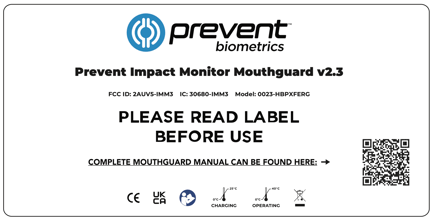
FCC ID: 2AUV5-IMM3
IC: 30680-IMM3
Solo Charging Case
FCC ID: 2AUV5-SOLOCASE2
IC: 30680-SOLOCASE2

Product Patent Protections– Mouthguard and/or Associated Mobile App
-
U.S. Patent 9,149,227 – DETECTION AND CHARACTERIZATION OF HEAD IMPACTS
-
U.S. Patent 9,289,176– CLASSIFICATION OF IMPACTS FROM SENSOR DATA
-
AU Patent 2011278996– DETECTION AND CHARACTERIZATION OF HEAD IMPACTS
-
AU Patent 2011278997– CLASSIFICATION OF IMPACTS FROM SENSOR DATA
-
CA Patent 2,805,252– DETECTION AND CHARACTERIZATION OF HEAD IMPACTS
-
CA Patent 2,805,250– CLASSIFICATION OF IMPACTS FROM SENSOR DATA
-
EP Patent 2,593,010– DETECTION AND CHARACTERIZATION OF HEAD IMPACTS (Validated in GB, DE, FR, IT, and ES)
-
EP Patent 2,593,015– CLASSIFICATION OF IMPACTS FROM SENSOR DATA (Validated in GB, DE, FR, IT, and ES)
Other Patents Pending
Prevent 2.0 and Prevent 2.3 iMG Technical Specifications
|
Performance |
|
|
Impact Detection Accuracy |
± 5% |
|
False Positive Filtering |
99% |
|
Range of Impact Detection |
± 200g |
|
Sample Rate |
3200 Hz |
|
BLE Range |
60ft (18.28m) |
|
Impact Data Storage |
1000 Impacts |
|
Mechanical |
|
|
Outer Material |
Food or Medical Grade Polyurethane and EVA |
|
Size (L,W,H) and Weight |
6.5” x 5.0” x 2.0”, 21g |
|
Environmental |
|
|
Temperature (Operation) |
-20 – 60°C / -4 – 140°F (use) |
|
Altitude (Max Operation) |
5000 meters (16,404ft) |
|
Temperature (Shipping & Storage) |
-20 – 45°C |
|
Power |
|
|
Charging Method |
Wireless |
|
Battery Type |
Polymer Lithium-ion |
|
Battery Life |
7 hours (in use, standby) |
|
Interface |
|
|
Impact event data transmission |
Bluetooth connection to iOS |
|
Indicators |
Red, Yellow, Green LEDs |
Individual Charger Case Technical Specifications
|
Power Supply |
|
|
Voltage input (DC volts) |
4.5 - 5.5 |
|
Maximum current draw (Amps) |
0.5 |
|
Mechanical |
|
|
Material |
Polypropylene |
|
Size (L,W,H) and Weight |
3.5” x 3.75” x 1.0”, 60g |
|
Environmental |
|
|
Humidity (Operation) |
65 ± 20% RH |
|
Temperature (Operation) |
0 - 45 °C / 32 – 113°F |
|
Altitude (Operation) |
5000 meters (16,404ft) |
|
Ultraviolet Sanitization |
|
|
UV wavelength (nm) |
280 |
|
Average UV power (mW) |
4 |
Team Charger Case Technical Specifications
|
Power Supply |
|
|
Voltage input (AC volts) |
100 - 240 |
|
Maximum current draw (Amps) |
1.52 |
|
Mechanical |
|
|
Material |
Polypropylene |
|
Size (L,W,H) and Weight |
22.8” x 18.3” x 11.7”, 10kg |
|
Environmental |
|
|
Humidity (Operation) |
65 ± 20% RH |
|
Temperature (Operation) |
0 - 45 °C / 32 – 113°F |
|
Altitude (Operation) |
5000 meters (16,404ft) |
|
USB Port |
|
|
USB voltage (V) |
5 |
|
Maximum USB current output (A) |
2 |
FCC Compliance Statement
This device complies with part 15 of the FCC Rules. Operation is subject to the following two conditions:
(1) this device may not cause harmful interference, and (2) this device must accept any interference received, including interference that may cause undesired operation.
CAUTION: The grantee is not responsible for any changes or modifications not expressly approved by the party responsible for compliance. Such modifications could void the user’s authority to operate the equipment.
NOTE: This equipment has been tested and found to comply with the limits for a Class B digital device, pursuant to part 15 of the FCC Rules. These limits are designed to provide reasonable protection against harmful interference in a residential installation. This equipment generates, uses, and can radiate radio frequency energy, and if not installed and used in accordance with the instructions, may cause harmful interference to radio communications. However, there is no guarantee that interference will not occur in a particular installation. If this equipment does cause harmful interference to radio or television reception, which can be determined by turning the equipment off and on, the user is encouraged to try to correct the interference by one or more of the following measures:
-
Reorient or relocate the receiving antenna.
-
Increase the separation between the equipment and receiver.
-
Connect the equipment into an outlet on a circuit different from that to which the receiver is connected.
-
Consult the dealer or an experienced radio/TV technician for help.
Canadian Compliance Statement
This device contains license-exempt transmitter(s)/receiver(s) that comply with Innovation, Science and Economic Development Canada license-exempt RSS(s). Operation is subject to the following two conditions:
(1) This device may not cause interference. (2) This device must accept any interference, including interference that may cause undesired operation of the device.
L'émetteur/récepteur exempt de licence contenu dans le présent appareil est conforme aux CNR d'Innovation, Sciences et Développement économique Canada applicables aux appareils radio exempts de licence. L'exploitation est autorisée aux deux conditions suivantes:
(1) L'appareil ne doit pas produire de brouillage; (2) L'appareil doit accepter tout brouillage radioélectrique subi, même si le brouillage est susceptible d'en compromettre le fonctionnement.
Airline Compliance and Certification
These instrumented mouthguards for team use include rechargeable batteries.
These batteries are certified to UN3481 Battery standards and are safe to travel on aircraft as they are at a capacity of 0.019 Ah or 0.07 Wh.